
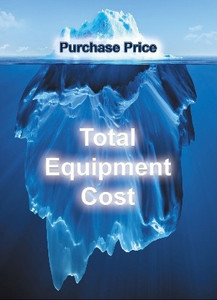
The True Cost of Pest Control Equipment: Why Purchase Price Is Just the Tip of the Iceberg
Posted by Andrew Greess on Sep 10, 2025
Have you ever calculated what your pest control equipment actually costs? The true cost is like an iceberg: only a small part is visible. The rest is hidden below the surface, waiting to sink your budget. Don't assume purchase price and cost are the same thing.

This article focuses on power spray equipment, but the same ideas apply to almost any equipment you buy for your business.
The Six Parts of Total Equipment Cost
| Cost | Questions to Ask Before You Buy |
|---|---|
| Purchase price | What's the total with options, sales tax, and freight? |
| Installation | What will it cost to mount and wire it in your vehicle? |
| Maintenance | What routine service does it need, and what do the parts and labor cost? |
| Repairs and downtime | How often does it break? Are parts in stock, or will you wait? |
| Productivity | Does the layout help your techs work faster, or slow them down? |
| Longevity | How long will the components last before they need replacing? |
1. Purchase Price
Purchase price is the most obvious part of total cost, and unfortunately it's often the only one considered. It includes the base unit plus any optional equipment, sales tax, and freight.
2. Installation Cost
Installation covers the total cost of mounting the equipment in your vehicle. Generally, sprayers that need electrical power, like 12-volt units and electric hose reels, cost more to install.
3. Maintenance Expense
Maintenance includes regularly scheduled service such as engine oil changes, pump rebuilds, and spray gun rebuilds, counting both parts and labor. Regular maintenance extends the life of your sprayer and prevents the unscheduled downtime caused by equipment failure.
4. Repair Costs and Downtime
Does the rig constantly break down? Repair cost includes not just the repair itself, but the downtime that follows, when a tech can't run a route. Are replacement parts readily available? Waiting on parts is a productivity killer. That's one reason we stock the pumps, reels, guns, and fittings we build our rigs with.
5. Productivity Impact
Does the equipment help your technicians or hold them back? Are key components positioned for easy, safe, ergonomic access? Does the tech have to make extra motions at every stop just to do the job? A few seconds wasted per stop adds up to hours per week across a route.
6. Longevity and Replacement Cost
How long will the components last? Are they quality, serviceable parts, or cheap parts designed to be thrown away? A rig built with good components can run for many years with routine maintenance.
Example: The Cheapest Part Can Cost You the Most
Plumbing fittings are some of the least expensive parts on a sprayer, yet they can cost you a bundle. A plastic fitting in the wrong place is easily damaged, leading to chemical spills, cleanup, and lost productivity. Using durable brass fittings in the right places costs a little more up front and saves far more over the life of the rig. When you order a sprayer, be sure you know exactly what you're getting.
Know Your True Costs
As an owner or manager, understanding the true cost of your equipment is critical to your business. Before you buy, compare the full cost of ownership, not just the price tag.
Every pest control sprayer we build in our Phoenix shop uses proven components we stock and service ourselves, and it's backed by our 90-day money back guarantee. Request a quote or call 602-371-1993 to talk through what you need.